
June 2026 – Care guidelines for DM patients, preparing for surgery and the brand new – My DM Support Plan!
Written by Becky Cartwright
Hello and welcome to CureDM Connect
Hello and welcome back to CureDM Connect monthly blog for June. We are officially half way through 2026, it is amazing just how fast time is going. This will be officially be my ninth month writing the CureDM Connect monthly blog and I can honestly say I am loving it! Over the next few months we are going to be focusing on some important topics within the DM community. These blog posts wont be focusing on CureDM updates as much as posts that people can refer back to for advice and guidance on important topics. If you would like to catch up on any of my previous blog posts you can do HERE. Thank you once again for checking out the blog and I hope you find this month filled with lots of helpful and important information.
Care Guidelines for DM patients
After a diagnosis of a condition such as Myotonic Dystrophy, there is a lot of new information to process. Things that never seemed important before, or maybe things you had never even thought about, become very important. Dealing with a diagnosis whether it be for yourself, a child, or a loved one can be a very daunting and scary time. With lots of appointments, tests and new information it can often feel overwhelming.
After my son’s and my own diagnoses, it took a while to process the new version of our life, and what life was going to look like. We are often faced within our community with health care professionals having a limited or little to no experience of treating patients with Myotonic Dystrophy, and I found myself very quickly feeling like I was educating the health care professionals around me. We do often say that we become the experts in our condition and learning to advocate and explain our symptoms and the difference in care needs can be tricky. Advocacy can be challenging for anyone, and dealing with such a complex condition such as DM, it is really helpful to have physical evidence and external guidelines that you can lean on.
Later in the blog I am going to be explaining a brand new project we are launching at CureDM to better support our community. CureDM have worked relentlessly over the years to collate relevant and informative guidelines to best support the individuals within the community. Being a rare disease, care guidelines are not always readily available, relevant or truly reflect the specialist care necessary. These guidelines help with day to day management of the condition and support in emergency situations too.
Support and Care Guides
You can see the full list of Support and Care Guides HERE or click the relevant subject header below:
- Emergency and planned surgery – anaesthetic guidelines
- Day to day living and support
- Consensus based DM clinical care recommendations and disease toolkit
- Help and support with medical care and disease management
As a family, we have made use of lost of these care guides available for things such as planned surgery, emergency A&E visits and annual reviews. If there is anything you feel you would like more support with or advice on please do reach out and we will always do our best to help you. We are always keeping up to date with current care guidelines, new research and keeping everything under review.
Surgery
An area which is really important to individuals with Myotonic Dystrophy is surrounding surgery. Planned or emergency surgery has recently been brought to the forefront for a lot of the community within CureDM, and having the right care guidelines, support and pre and post operative plans in place is so important. The surgery section of the care guides is packed full of care and anaesthetic management which as we know is a big risk factor for DM patients. General Anaesthetic can be dangerous for people with DM, more so because the effects happen AFTER the surgery during recovery, when it is often presumed all is well so people become less concerned. Often medical professionals are not 100% aware of the severity of these dangers, so we have produced a reference guide. This is helpful to print off and take to any surgery appointments. We understand surgery is often medically necessary, and emergencies happen, but making the team around you aware of the risks is very important and can be life-saving.
We have had a recent encounter with surgery as my little one, Toby, is needing to have surgery this year. While the surgery itself is very straightforward and routine we have been very proactive in our approach to his pre and post operative care. Having a strong rapport with the hospital and staff within the department has definitely helped with this, and ensured they are aware of his level of need well in advance. As part of the process, I have outlined some key factors to think about below. This is not going to work for everyone and will not be relevant for everyone but hopefully gives some ideas of questions or things to think about:
- Booking in the surgery – When we were first discussing the need for surgery, I ensured the surgery was done as an inpatient case and not a day case. This meant Toby would be an inpatient and monitored for at least 24 hours and overnight – this is vital for any form of anaesthetic – specilaists advise that in all procedures, a person with DM goes up one level of care (if it would be a day case, it needs overnight, f it would be a GA followed by normal ward, it needs HDU, etc)
- Date and time – We liaised with the hospital for a date that was going to work for Toby and asked for a morning surgery time. Due to anaesthetic risks, being first on the list makes sure there is no cross contamination of tubes etc, and there is plenty of time for recovery monitoring. We also thought about the logistics of dates and when we would have support available to us at home.
- Pre-operative questionnaire – We were asked to fill in a very thorough pre-op questionnaire, this gave me the chance to outline any concerns and questions and I also wrote some questions for me to go over at our pre-op meeting.
- Pre-op meeting with anaesthesiologist – As part of the pre-op plan, and due to the anaesthetic risks, we had a meeting to discuss the anaesthetic Toby would have and the after care. This was when we discussed again Toby being an inpatient and gave them a copy of the anaesthetic guideline from CureDM and Toby’s personalised Pen Profile.
- On the day – Unfortunately, Toby’s surgery was cancelled the morning of his surgery. We still had lots of conversations with surgeons, nurses and his anaesthesiologist where we continued to highlight the level of need and all relevant paperwork.
- Why was it cancelled – The surgery was cancelled due to there being no available HDU (High dependency unit) beds for after the surgery for Toby. Having a HDU/ICU bed available not only for complications or emergencies after surgery is really important and is definitely something we recommend asking before surgery so that they are adequately prepared for every eventuality. Remember, in DM issues arrise in the 24-48 hours AFTER a General Anaesthetic, so this is the time that monitoring for respiratory and cardiac effects is most important!
Myotonic Dystrophy Support Plan
CureDM Support Plan is something I have been working on for CureDM for a few months. I was keen to help design and plan something that would help families feel more in control and help them keep up to date with appointments and information, building on my own experiences of what helped us as a family. We received Toby’s diagnosis at 3 weeks old and being first time parents, sleep deprived, and myself being fresh post-partum, it was a really overwhelming and scary time for us. I don’t feel like you ever forget those initial conversations about being diagnosed, however, we were at lots of appointments with new faces and were given so much new and complex information that we were often left confused and overwhelmed. As time passed, it did get slightly easier but I still didn’t feel very in control. With the help of CureDM and support from Emma-Jayne who sent over lots of resources and links to things I could print, I collated it all and developed what we have decided to call ‘My DM Support Plan’. Check out the webpage HERE
Downloads available:
- Pen Picture template, with example copy of Miles’ Pen Picture
- List of personal health care professionals and contact details: template
- CAMRARE patient passport – lanyard version
- Consensus based care recommendations for DM (adult or child)
- CureDM basic anaesthetic guidelines
- MDUK neuromuscular care plan template
- MDF: A guide to DM for school professionals
- International Myotonic Dystrophy Awareness Day poster
- Could it be Myotonic Dystrophy? poster
- Myotonic Dystrophy at a glance poster
- MDF clinic planner for notes
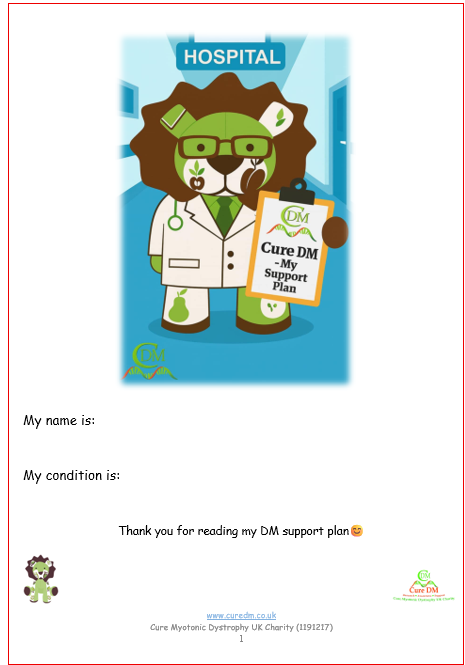
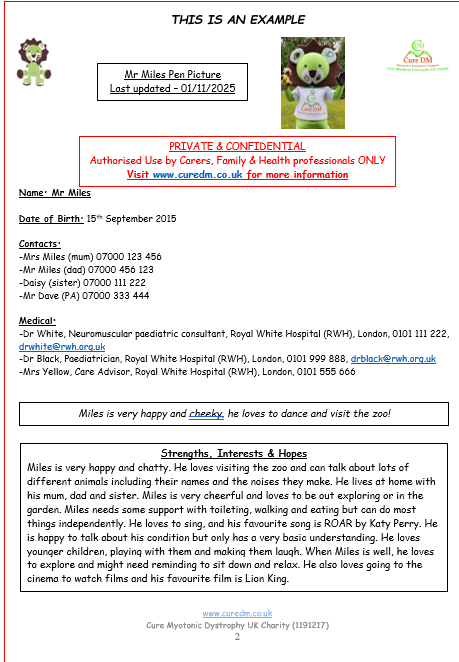
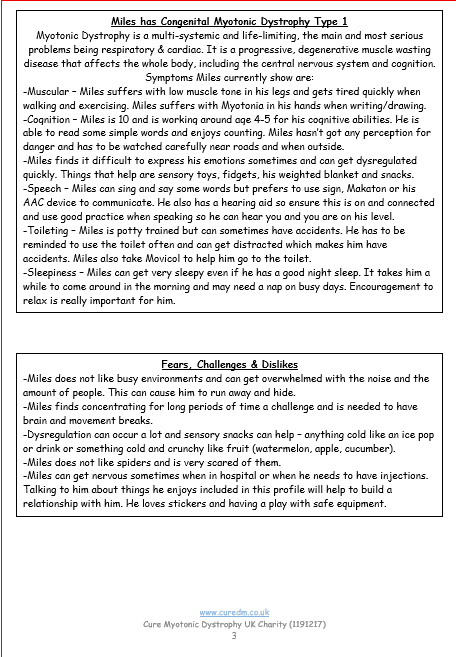
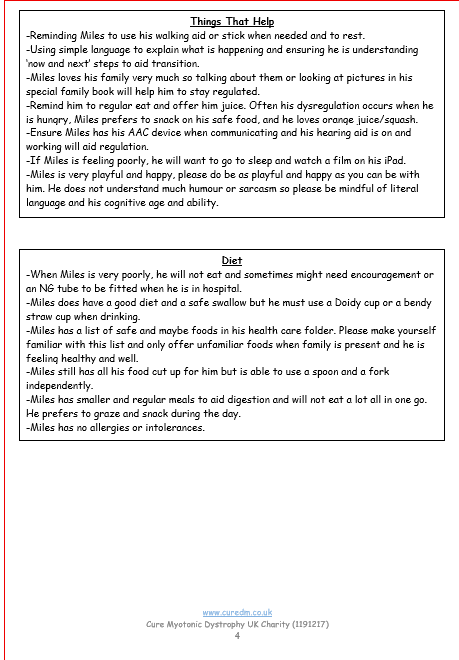
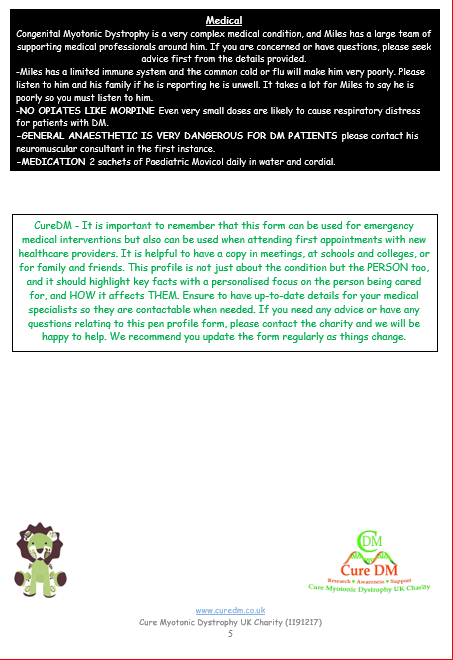
This folder of documentation is intended to be taken along to all appointments whether it be GP, annual reviews with consultants, transfer of care meetings and more. It is completely customisable and you can include whatever you feel is necessary, adding and removing as things change. It also includes a Pen Profile Template AND example copy for our mascot Miles! I have included tips about what else to put in, such as a notebook for notes or questions, information regarding other health conditions and when to review your plan.
As a family, we have found the folders to have been of great help to us in lots of different scenarios. It is great to have everything in one place and putting it somewhere I can just grab and take them when I need too. I always make sure I have some documents relating to CureDM so I am able to talk about the Charity. Most recently, I had a neuromuscular annual review and was talking about the amazing work CureDM do, and the charity is now being added to the list of dedicated charities the hospital will signpost people to for support. This is such a positive step and will hopefully make a difference to a newly diagnosed family, for relatively minimal work from me!
I make sure I regularly look at the our list of specialists where I can see emails and phone numbers and pass these on if I need too, and also last see when we were seen and if anything needs chasing. I always ensure I have a pen and some plain paper in case I want to take any notes or have any questions I would like to ask. Lastly, the pen profiles for us have been fantastic to make sure Toby is seen as an individual and not just in a medical sense.
Being able to hand these out to all the new professionals within Toby’s Team and them having all the most important details about him readily available has been so helpful. Little things like diet habits, like and dislikes, things that help, what I look like when I am okay/not okay, how DM affects Toby specifically, communication needs and allergies, are really important for emergency hospital visits or emergency admissions where people can see everything they need to know straight away. We have also reached out to our local GP, hospital trusts and community hubs to ensure there is an online copy attached to Toby’s case so everyone working with Toby can access them.

Education
Pen Profiles have also been super helpful in regards to education and the transition to different settings, in fact this is where the idea first came from, many years ago when Dregan (Emma-Jayne and Petes son) was navigating the education system. With lots of transitions within the early years from room to room at nursery, then onto pre-school and primary up to secondary school, it can be challenging If you receive support from your local authority, SEND team, Early learning and childcare team, EHCP or more Pen Profiles can be really helpful.
Within education, there are often lots of teams of people working around one child, and we found new professionals would be in and out of Toby’s educational journey offering support. Having one document that outlined not just Toby’s medical background but his personal, social and emotional needs made those transitions easier and professionals felt they could understand his needs before they met him. This would often lead to more productive and easier first meetings as they knew Toby and what he did or did not need. Emma-Jayne found them invaluable when moving from teacher to teacher through primary and high school settings, to try to avoid the first months of term being the ‘learning about Dregan’ block, and making sure the support was there from day one.
The support available within the early years and education in general can be vast but complex, CureDM can offer a Myotonic Guide for school professionals which offer a very easy to read yet comprehensive guide to understanding Myotonic Dystrophy and learning and education. This could be the first time educational professionals are teaching and supporting a child with a neuromuscular condition, this has certainly been the case for us. We have been blessed with practitioners eager to learn and grow with Toby and his needs and having the guidelines to ease that process is really helpful. Supporting a child DM1 or CDM1 within their educational journey is really important to allow them to reach their full protentional, CureDM are always on hand to support you and your family. Please do reach out if you have any education related questions.
CureDM is here for you!
CureDM is here for you, whether you are newly diagnosed, your child has been diagnosed or your are the loved one of someone who has been diagnosed within your family. No matter what stage of the journey you are on, we are here to support you. CureDM have worked passionately for over a decade to support the individuals within the DM community and despite us being a small charity with a small but hardworking team of trustees and volunteers, we make up for that in our dedicated to make a difference personal reasons for being involved. We are very grateful for everyone that supports our charity from volunteers to passionate fundraisers and all the family and individuals that work so hard to help raise awareness of Myotonic Dystrophy. Please remember to keep up-to-date with the charity here are a few ways you can do so:
- Monthly blog you can find HERE
- Private UK Facebook page for families and people living with DM HERE
- Facebook page HERE
- Email us on – curedm@outlook.com
Thank you!
Thank you so much for taking the time to read this months blog all about care guidelines within the DM community. I hope you have found it helpful and this blog will be here to refer back to whenever you might need. Please keep in touch and your eyes peeled for the July blog when we will be reflecting back on the CureDM Family Day from Drayton Manor and talking about CureDM’s Awareness Day Campaign. Thanks so much!
Becky Cartwright – CureDM Social Content and Engagement Lead